Solder Wire Types and Gauge: A Complete Buyer's Guide
Solder wire explained: a size chart in mm, inches and AWG, 60/40 vs 63/37 vs lead-free, flux core types and percentages, and which diameter to use for electronics.
Written by Kerem Başbuğ · Last updated September 16, 2026 · How we rank
5 min read
Affiliate disclosure: As an Amazon Associate we earn from qualifying purchases. We may earn a commission when you buy through links on this page — at no extra cost to you. Read our affiliate disclosure for details.
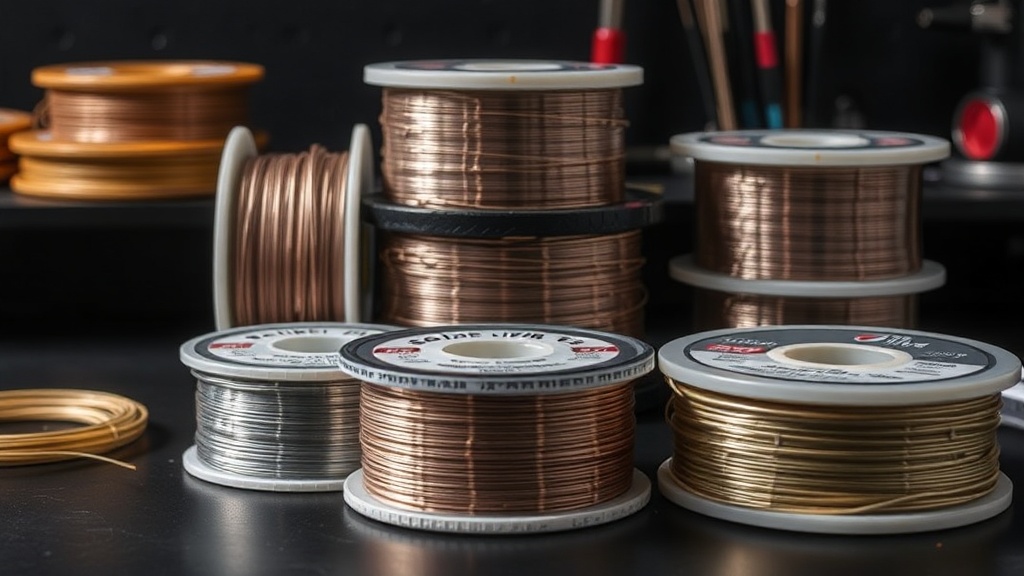
Walk into the solder aisle and the choices multiply fast: tin-lead ratios, diameters, flux cores, lead-free alloys. For electronics, though, the decision is simpler than it looks. Here is everything you actually need to know to buy the right spool.
The short answer
If you want one spool for learning and hobby electronics, buy 0.8 mm (0.031”) 63/37 or 60/40 rosin-core solder. Add a thinner 0.5–0.6 mm spool for surface-mount work, and a lead-free spool when your projects call for it.
Leaded vs lead-free
The first fork in the road. Leaded solder — usually 60/40 or 63/37 tin-lead — melts at a lower temperature (around 183–190°C) and flows beautifully, which makes it the easiest to learn on. Lead-free solder (typically SAC alloys with tin, silver and copper) melts hotter (about 217–227°C) and is stickier, but it is required for anything sold commercially or handled by children.
Our full breakdown lives in the lead-free vs leaded guide; the short version is learn on leaded, switch to lead-free when you need to. A spool of 60/40 rosin-core wire is the ideal first purchase.
Types of solder wire
| Type | Example alloy | Melting point | Use it for |
|---|---|---|---|
| Eutectic leaded | Sn63/Pb37 | 183°C (361°F) | The most forgiving choice for hobby electronics |
| Standard leaded | Sn60/Pb40 | 183–190°C (361–374°F) | Learning, repairs, general electronics |
| Silver-bearing leaded | Sn62/Pb36/Ag2 | about 179°C (354°F) | Silver-plated parts and terminals |
| Lead-free SAC | SAC305 (Sn96.5/Ag3/Cu0.5) | 217–220°C (423–428°F) | Commercial and child-safe electronics |
| Lead-free tin-copper | Sn99.3/Cu0.7 | about 227°C (441°F) | Budget lead-free, larger joints |
| Low-temperature | Sn42/Bi58 | 138°C (280°F) | Heat-sensitive parts; brittle, niche use |
| Acid-core / plumbing | Various | Varies | Plumbing and metalwork only — never electronics |
60/40 vs 63/37
Among leaded solders you will see two ratios:
- 60/40 has a small “plastic range” — a few degrees where it is half-set as it cools. Disturb a joint in that window and you can get a dull, weak cold joint.
- 63/37 is eutectic: it changes straight from liquid to solid with no pasty phase. That makes it slightly more forgiving and the choice of many professionals.
Both are great. If you can find 63/37 easily, take it; if not, 60/40 is perfectly good.
Solder wire gauge chart
Solder “gauge” just means diameter. Listings mix millimetres, inches and wire gauge numbers, so here is how they line up:
| Diameter (mm) | Inches | Approx. AWG | Best for |
|---|---|---|---|
| 0.3 mm | 0.012” | 28 AWG | Very fine-pitch SMD and rework |
| 0.5 mm | 0.020” | 24 AWG | Surface-mount parts, fine through-hole |
| 0.6 mm | 0.024” | 22–23 AWG | Fine or dense electronics, small SMD |
| 0.8 mm | 0.031” | 20 AWG | The all-rounder — most through-hole work |
| 1.0 mm | 0.039” | 18 AWG | Larger joints, wires, connectors |
| 1.2 mm | 0.047” | 16–17 AWG | Thick wires, terminals |
| 1.6 mm | 0.063” | 14 AWG | Heavy wire, battery and power leads |
AWG figures are approximate and are there to help you compare listings; some sellers use SWG instead, where 0.8 mm is roughly 21 SWG.
Choosing a diameter
Thinner wire gives you finer control over how much solder you feed; thicker wire delivers more, faster.
- Too thick and you flood small pads with solder, causing bridges and blobs.
- Too thin and you spend ages feeding solder into a large joint while the tip cools.
If you buy one spool, make it 0.8 mm — it handles the vast majority of hobby joints comfortably. Match the solder to the job the same way you match the iron temperature.
Flux core: type and size
Almost all electronics solder is flux-core (often called rosin-core): the wire has one or more channels of flux running through it. As the solder melts, the flux is released exactly where it is needed to clean the joint.
Flux type is usually printed on the label:
- R (rosin) — mild, traditional rosin flux.
- RMA (rosin mildly activated) — a little more cleaning power; a popular hobby choice.
- RA (rosin activated) — stronger cleaning for oxidized parts; clean the residue off afterwards.
- No-clean — leaves minimal, non-corrosive residue that can usually stay on the board.
- Water-soluble — very active, but the residue must be washed off promptly.
Flux percentage is the share of the wire’s weight that is flux — commonly around 1–3%. Around 2% is a good all-round figure. Some wire has several separate cores (“multi-core”) to spread the flux evenly.
Never use acid-core or plumbing solder on electronics — the acid flux corrodes copper and ruins boards. For more on flux, see our how to use flux guide.
How to read a solder label
A typical spool might read: Sn63Pb37 · 0.8 mm · 2.2% · RMA · 100 g
- Sn63Pb37 — 63% tin, 37% lead (Sn is tin, Pb is lead, Ag is silver, Cu is copper, Bi is bismuth).
- 0.8 mm — the diameter.
- 2.2% — the flux content by weight.
- RMA — the flux type.
- 100 g — the weight of solder on the spool.
How much to buy
A 50–100 g spool lasts a beginner a long time. Buy a small spool of leaded 0.8 mm to learn on, and add a thinner 0.5–0.6 mm spool and a lead-free spool later as your projects demand. Pair it with good flux and a temperature-controlled iron, and you have everything the metal side of soldering requires.
Storage and safety
Keep solder in a dry place and away from food. Leaded solder is safe to handle with sensible habits — wash your hands afterwards, do not eat at the bench, and ventilate the flux fumes, which are the real irritant whichever alloy you use.
Ready to put it to use? Try a practice kit and follow the beginner soldering walkthrough.
Recommended kits from this guide

HGMZZQ
HGMZZQ 60/40 Rosin-Core Solder Wire
Classic 60/40 rosin-core wire — the easiest solder to learn on.
We earn a commission, at no extra cost to you.
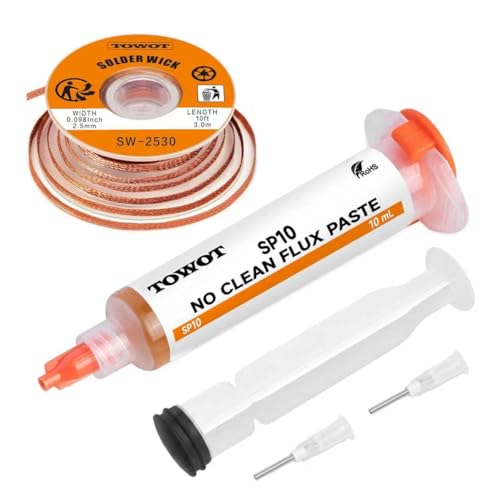
TOWOT
TOWOT Solder Wick & Flux Kit
Solder braid plus no-clean flux — the cleanup duo.
We earn a commission, at no extra cost to you.

amomii
amomii Testudo Soldering Practice Kit
Three real gadgets, guided tutorials, and an Arduino-compatible brain.
We earn a commission, at no extra cost to you.