Skip to content
SolderingPracticeKit

The Best Oscilloscopes for Beginners

A multimeter tells you a single number; an oscilloscope shows you what a signal does over time. That is the difference between knowing a circuit has power and seeing why it misbehaves. We ranked the scopes that make sense for hobbyists, from a pocket learning tool to a four-channel bench instrument.

Written by · Last updated September 28, 2026 · How we rank

Affiliate disclosure: As an Amazon Associate we earn from qualifying purchases. We may earn a commission when you buy through links on this page — at no extra cost to you. Read our affiliate disclosure for details.

At a glance

Product Best For Our Score Price Amazon link
Makers debugging digital and microcontroller circuits who want four channels.
9.1
See on Amazon $$$ Check Price →
Hobbyists who want a capable scope that is portable and covers three jobs.
8.9
See on Amazon $$ Check Price →
Hobbyists moving to microcontroller debugging who want a bench scope on a budget.
8.6
See on Amazon $$ Check Price →
FNIRSI DSO152 Handheld Oscilloscope 200kHz Bandwidth, 2.5MS/s Sampling Rate
Best First Oscilloscope FNIRSI DSO152 Handheld Oscilloscope
Beginners and students who want to see signals for the first time without a big outlay.
8.0
See on Amazon $ Check Price →

The oscilloscopes, reviewed

1 Best 4-Channel Scope
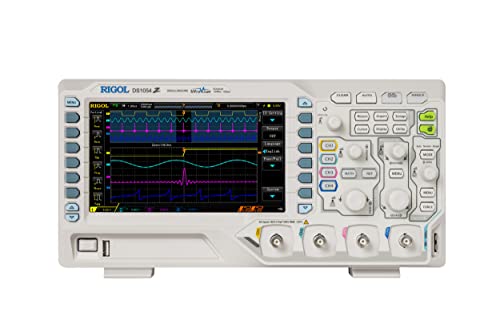
Rigol DS1054Z Digital Oscilloscope, 50MHz, 4 Channel, 1GSa/s, Best Value
Check Price →

We earn a commission, at no extra cost to you.

Rigol

Rigol DS1054Z 4-Channel Digital Oscilloscope

9.1 / 10
Best for: Makers debugging digital and microcontroller circuits who want four channels.

The one to buy if you debug digital circuits: four channels let you watch clock, data and control lines together, and the user community is huge.

Watch out for: 50MHz bandwidth is modest for the price

Read the full Rigol DS1054Z 4-Channel Digital Oscilloscope review — pros, cons and verdict →
2 Best Handheld Oscilloscope
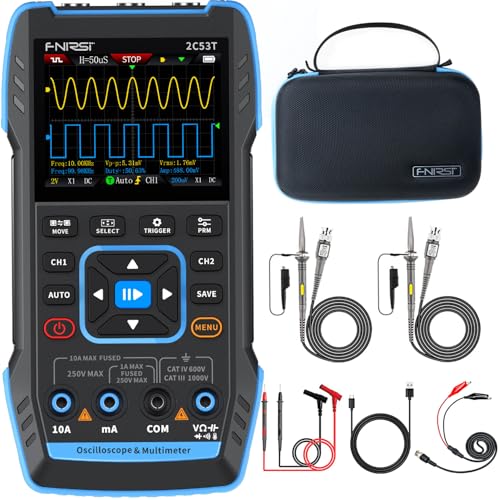
FNIRSI 2C53T 3-in-1 50MHz 2CH Oscilloscope Multimeter DDS Signal Generator
Check Price →

We earn a commission, at no extra cost to you.

FNIRSI

FNIRSI 2C53T 3-in-1 Oscilloscope, Multimeter & Signal Generator

8.9 / 10
Best for: Hobbyists who want a capable scope that is portable and covers three jobs.

Our pick for most hobbyists: two channels, 50MHz, plus a multimeter and signal generator, in a handheld that also goes to repairs.

Watch out for: Small screen compared with a bench scope

Read the full FNIRSI 2C53T 3-in-1 Oscilloscope, Multimeter & Signal Generator review — pros, cons and verdict →
3 Best Budget Bench Scope
Hantek DSO2C10 Digital Storage Oscilloscope 100MHz Bandwidth 2CH
Check Price →

We earn a commission, at no extra cost to you.

Hantek

Hantek DSO2C10 100MHz Digital Oscilloscope

8.6 / 10
Best for: Hobbyists moving to microcontroller debugging who want a bench scope on a budget.

The cheapest route to a real benchtop scope: 100MHz and dedicated controls make microcontroller debugging much quicker than on a handheld.

Watch out for: Only two channels

Read the full Hantek DSO2C10 100MHz Digital Oscilloscope review — pros, cons and verdict →
4 Best First Oscilloscope
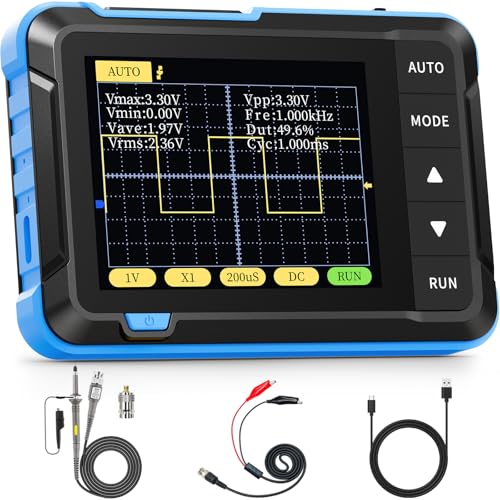
FNIRSI DSO152 Handheld Oscilloscope 200kHz Bandwidth, 2.5MS/s Sampling Rate
Check Price →

We earn a commission, at no extra cost to you.

FNIRSI

FNIRSI DSO152 Handheld Oscilloscope

8.0 / 10
Best for: Beginners and students who want to see signals for the first time without a big outlay.

The cheapest way to learn what an oscilloscope shows you. Fine for audio, PWM and 555-timer kits; too slow for microcontroller signals.

Watch out for: 200kHz bandwidth rules out fast digital signals

Read the full FNIRSI DSO152 Handheld Oscilloscope review — pros, cons and verdict →

How to choose your first oscilloscope

The three specifications that matter

SpecificationWhat it meansHobby guideline
BandwidthThe highest frequency it shows accurately50–100MHz for digital projects; less for audio and PWM
Sample rateHow often it measures the signalWell above the bandwidth — 1GSa/s is comfortable
ChannelsHow many signals you can see at onceTwo for most work; four for digital debugging

What you can see with a scope that a meter misses

A meter averages; a scope shows shape. With one you can see whether a 555 timer in a kit is actually oscillating, whether a PWM signal driving an LED or motor has the duty cycle you expect, whether a power rail is noisy, and whether a microcontroller is sending anything on its communication pins. Those are exactly the faults that leave a board powered but not working.

Getting good measurements

Match the probe attenuation setting to the probe switch, compensate each probe on the scope's calibration output, and keep the ground lead short. Most confusing first measurements come from one of those three. For power, pair the scope with a current-limited bench power supply, and keep a multimeter for quick continuity checks.

New to building a bench? Our electronics workbench guide explains which tool to buy first and why.

Frequently asked questions

What is the best oscilloscope for a beginner?
For most hobbyists, a two-channel 50MHz handheld such as the FNIRSI 2C53T is the best start — it also works as a multimeter and signal generator. If the scope will live on a bench, a benchtop model like the Hantek DSO2C10 is easier to learn on thanks to its bigger screen and dedicated knobs.
How much bandwidth do I need?
A common rule of thumb is bandwidth several times higher than the fastest signal you want to see accurately. For audio, PWM and slow signals, even a few hundred kilohertz works; for Arduino-class digital projects, 50–100MHz is comfortable.
Handheld or benchtop oscilloscope?
Benchtop scopes have larger screens and a knob for every control, which makes learning and everyday debugging faster. Handhelds are cheaper, portable and often combine a multimeter and signal generator. Choose by where the scope will be used.
Do I need an oscilloscope to learn soldering?
No — a multimeter handles most kit fault finding. An oscilloscope becomes valuable when a circuit powers up but misbehaves, because it shows how signals change over time.
How many channels should an oscilloscope have?
Two channels cover most hobby work, such as comparing an input with an output. Four channels help when debugging digital circuits with several related signals, such as a clock, data and chip-select line.