Soldering Fume Safety: What You're Breathing and How to Stop It
Soldering fumes explained: what flux smoke actually is, the health risks, and how to protect yourself with ventilation and a fume extractor.
Written by Kerem Başbuğ · Last updated September 30, 2026 · How we rank
4 min read
Affiliate disclosure: As an Amazon Associate we earn from qualifying purchases. We may earn a commission when you buy through links on this page — at no extra cost to you. Read our affiliate disclosure for details.
The wisp of smoke that curls up when solder melts is so routine that most beginners never think about it. They should — not because it is acutely dangerous, but because it is the one soldering hazard that is genuinely easy to ignore and genuinely worth managing.
What the smoke actually is
Here is the key fact: the smoke from soldering is vaporised flux, not lead. Lead melts at around 327°C but does not boil or vaporise until far higher temperatures than any soldering iron reaches. So the white plume you see is the rosin flux — the stuff inside your rosin-core solder — burning off as it does its job.
That changes how you protect yourself. The airborne risk is the flux smoke; the lead risk is from handling leaded solder and then touching your mouth, which is why hand-washing matters (more on that below).
The health risk
Rosin flux fume is a recognised respiratory sensitiser. Occasional exposure in a ventilated room is low-risk, but regular, close-up inhalation can cause:
- Eye, nose and throat irritation
- Coughing and respiratory discomfort
- With heavy long-term exposure, occupational asthma
The dose makes the poison. A few minutes a month near an open window is very different from hours every day hunched over a board with the smoke drifting straight up into your face.
How to protect yourself
1. Keep the smoke out of your face. This is the simplest, highest-impact step. A small carbon-filter fume extractor sat beside your work pulls the plume sideways and away from you. It is the cheapest meaningful safety upgrade you can make.
2. Ventilate. Even an open window makes a real difference. For frequent soldering, the gold standard is a fume extractor that vents outside rather than just filtering and recirculating.
3. Do not lean directly over the joint. Position yourself so the rising smoke does not pass your nose. A little distance and a slight angle go a long way.
4. Handle leaded solder responsibly. Although the fumes are essentially lead-free, the solder itself is not. Do not eat or drink at the bench, and wash your hands when you finish. Better still, use lead-free solder for work that will be handled by others or by children.
A sensible setup
You do not need a lab. A decent station or iron, a small fume absorber beside your work, a window cracked open, and clean hands afterward covers the vast majority of hobby soldering safely. Add safety glasses when clipping component legs and you have a bench you can use for years without worry.
Ventilation options compared
| Option | What it does | Good for |
|---|---|---|
| Open window | Dilutes fumes in the room | The minimum for any indoor soldering |
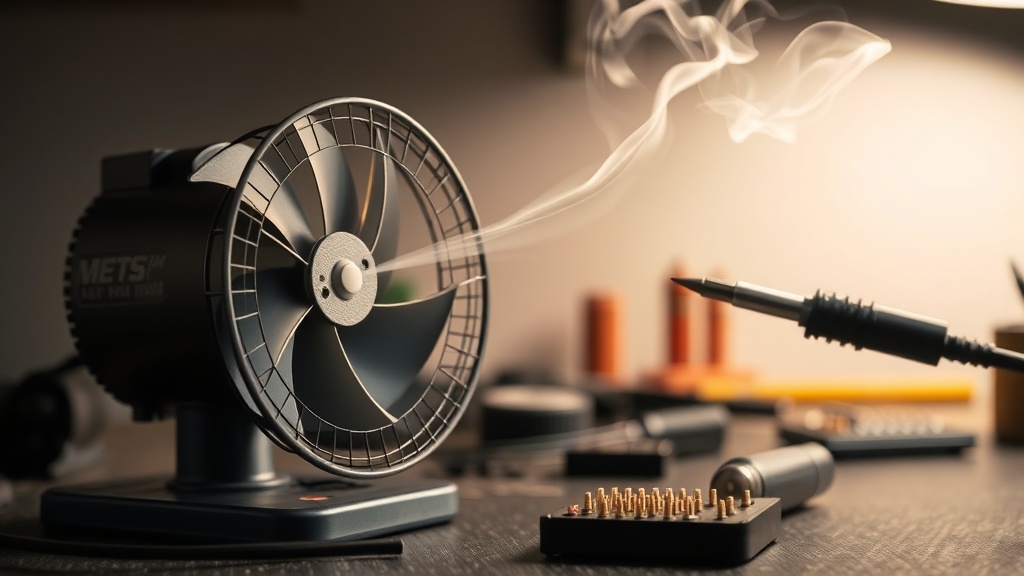
| Desk fan blowing away from you | Moves smoke out of your breathing zone | Occasional short sessions |
| Carbon-filter fume extractor | Pulls smoke through a filter beside the work | Regular hobby use — see the KOTTO extractor |
| Extractor with a flexible arm | Captures smoke right at the joint | Longer or more frequent sessions |
| Ducted extraction to outside | Removes fumes from the room entirely | Classrooms, makerspaces, heavy use |
Position matters as much as the device: an extractor works best close to the joint and slightly to the side, not above your head where the smoke passes your face first.
Choosing a fume extractor
- Capture distance: the closer it sits to the joint, the more it catches; a small unit near the work beats a bigger one across the bench.
- Filter type: activated carbon absorbs some of the fumes; units with a particle pre-filter handle heavier use better.
- Replaceable filters: check they are available and inexpensive, and replace them when they darken or the smell returns.
- Noise: you will run it for whole sessions, so a quieter fan matters.
The other soldering hazards
Fumes are the easiest hazard to ignore, but not the only one:
- Burns: always return the iron to its stand, and never catch a falling iron.
- Eyes: solder and flux can spit, and clipped leads fly — wear safety glasses.
- Lead hygiene: with leaded solder, wash your hands after soldering and never eat or drink at the bench.
- Flux on skin: some people find rosin irritating; wash it off and consider gloves for long rework sessions.
- Fire: keep paper and solvents away from the iron, and switch it off when you leave the bench.
Soldering with children and in classrooms
Groups multiply the fumes. Use extraction at every station or strong ventilation, keep sessions short, and choose lead-free solder for anything children will handle. Our parent’s guide to soldering with kids covers supervision and age.
For the full beginner kit, see our tools checklist, and if children are involved, read our soldering with kids guide.
Recommended kits from this guide

KOTTO
KOTTO Solder Fume Extractor
Keep solder smoke out of your face for the price of a tip set.
We earn a commission, at no extra cost to you.

HGMZZQ
HGMZZQ 60/40 Rosin-Core Solder Wire
Classic 60/40 rosin-core wire — the easiest solder to learn on.
We earn a commission, at no extra cost to you.
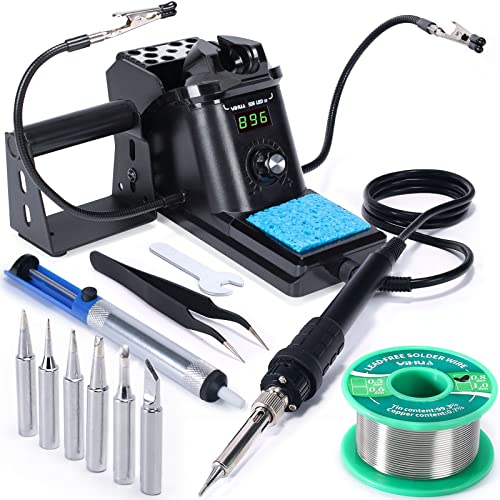
YIHUA
YIHUA 926 III 60W Soldering Station
A temperature-controlled station bundled with everything to start.
We earn a commission, at no extra cost to you.