
NANKADF
NANKADF 30V 10A Bench Power Supply
8.5 / 10
An encoder knob and a proper output on/off button make setup safer.
Check Price →
Read full review →
We earn a commission, at no extra cost to you.
Reviewed by Kerem Başbuğ · Last updated September 28, 2026 · How we rank
An adjustable 0–30V, 0–10A switching bench supply with a 4-digit LED display, coarse and fine adjustment and a 5V USB port. It is the tool that lets you power a project with a current limit instead of hoping a battery or wall adapter does not cook it.
A current-limited bench supply is the most underrated tool on a hobby bench: set the voltage, set a sensible current limit, and a wiring mistake shows up as a current reading instead of a burnt component. The SPS-3010 does that simply and precisely. Its switching design is noisier than a linear supply, which matters only for sensitive audio or analogue work.
We earn a commission, at no extra cost to you.
Contents come from the current Amazon listing and can change — check the listing before buying.
Before connecting anything, set the voltage with the output open, then short the leads briefly and set the current limit — for a small kit, a few hundred milliamps is a sensible start. Connect the project and watch the current display: if it hits the limit immediately, there is a short or a reversed part. Raise the limit only when the circuit behaves.
Hobbyists who want to power and test projects safely with an adjustable current limit.

Adds memory presets and a key lock, useful if you switch between the same voltages often.
An encoder knob and an output on/off button for a similar price.
NANKADF
An encoder knob and a proper output on/off button make setup safer.
We earn a commission, at no extra cost to you.
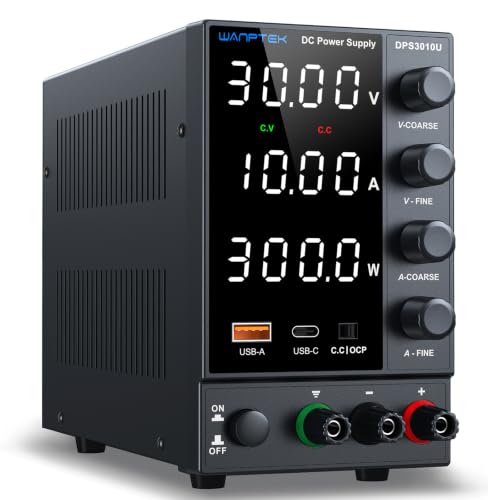
WANPTEK
Encoder coarse and fine control plus USB-A and USB-C quick-charge.
We earn a commission, at no extra cost to you.
WANPTEK
Memory presets, an output switch and a key lock for repeatable, safe setups.
We earn a commission, at no extra cost to you.
